
Last updated August 25, 2026
Free on-site gate assessment - hinges, posts, and your LiftMaster or Nice gate operator checked before anything is quoted
The assessment is free and the quote is the invoice.
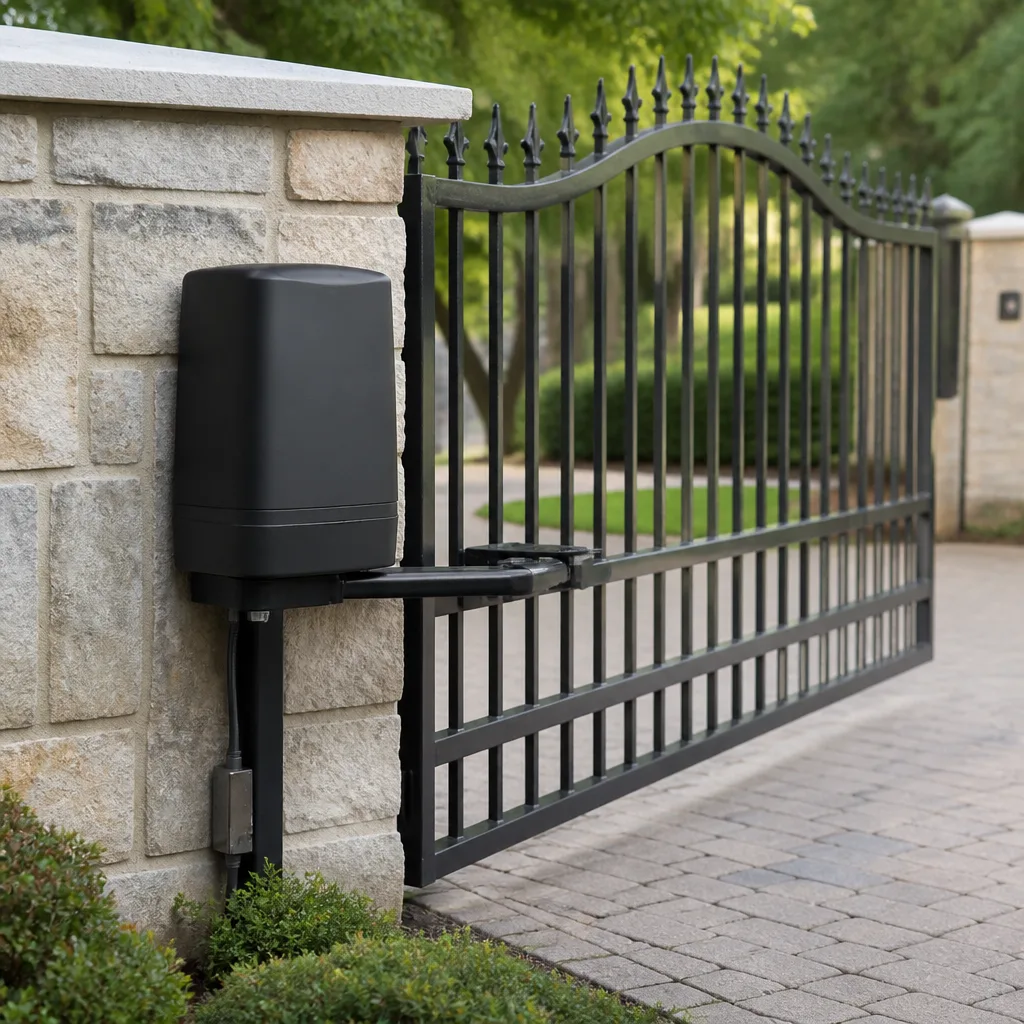
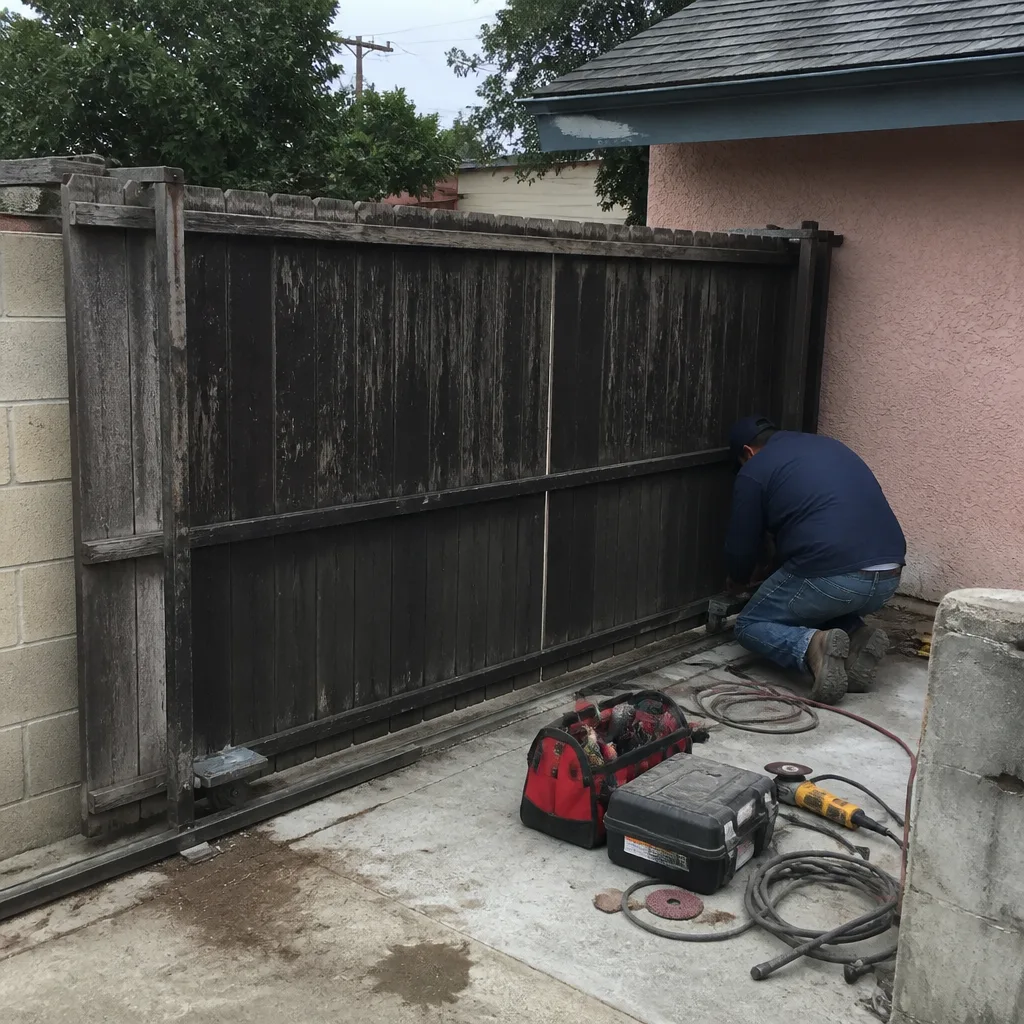 Before
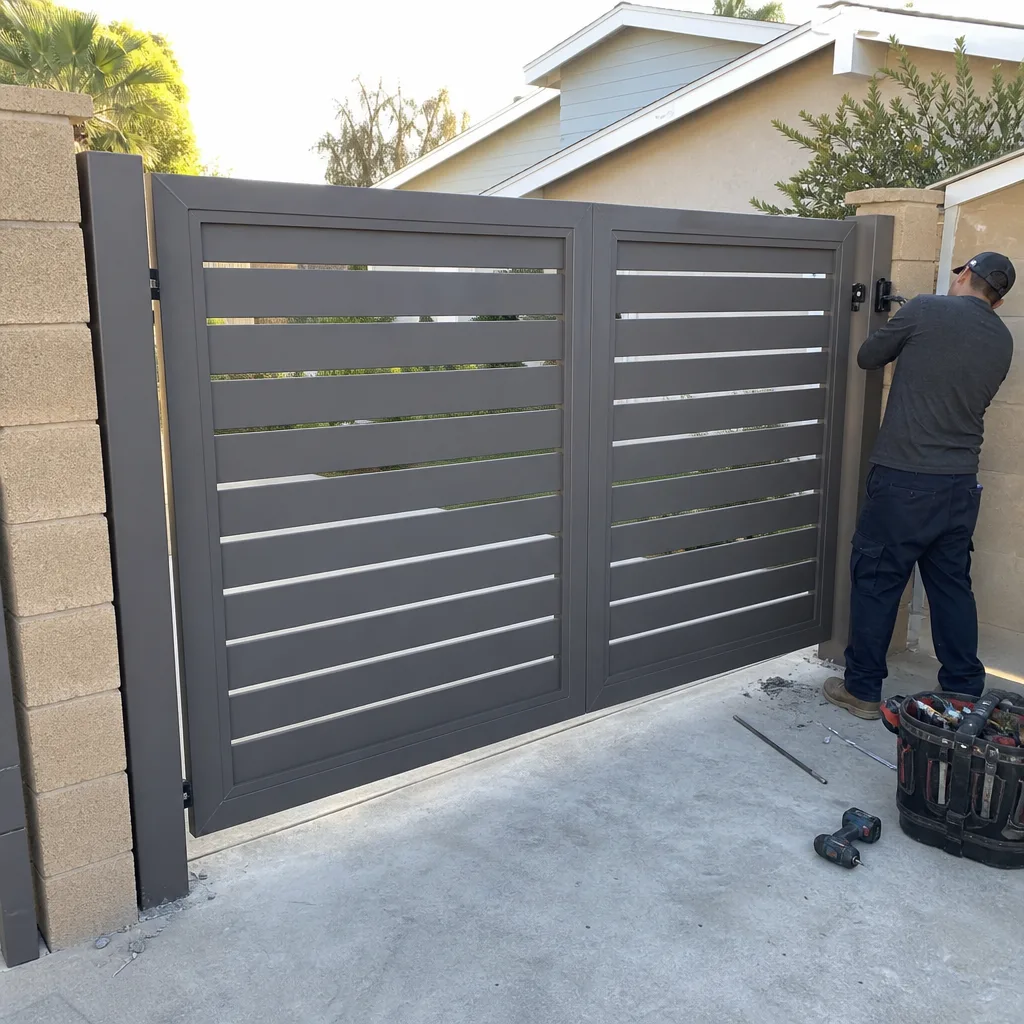 After
After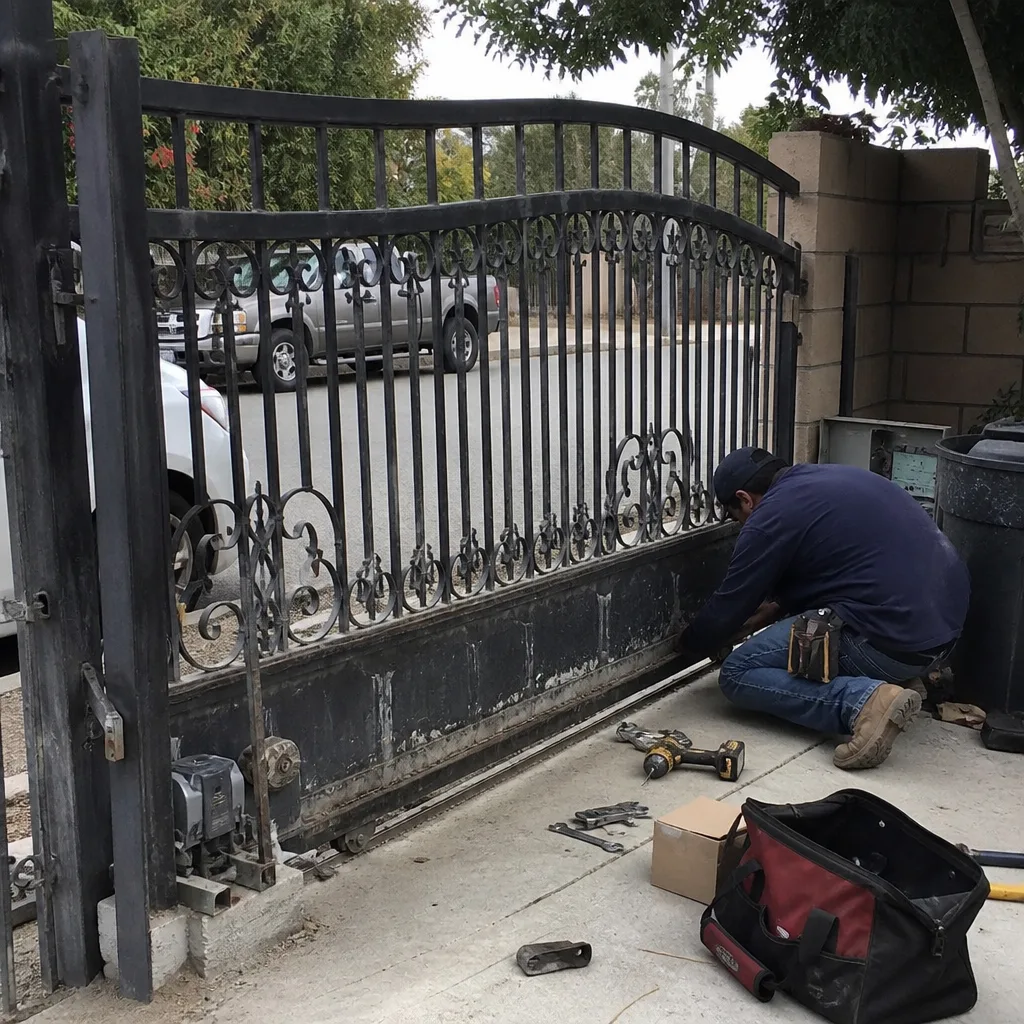 Before
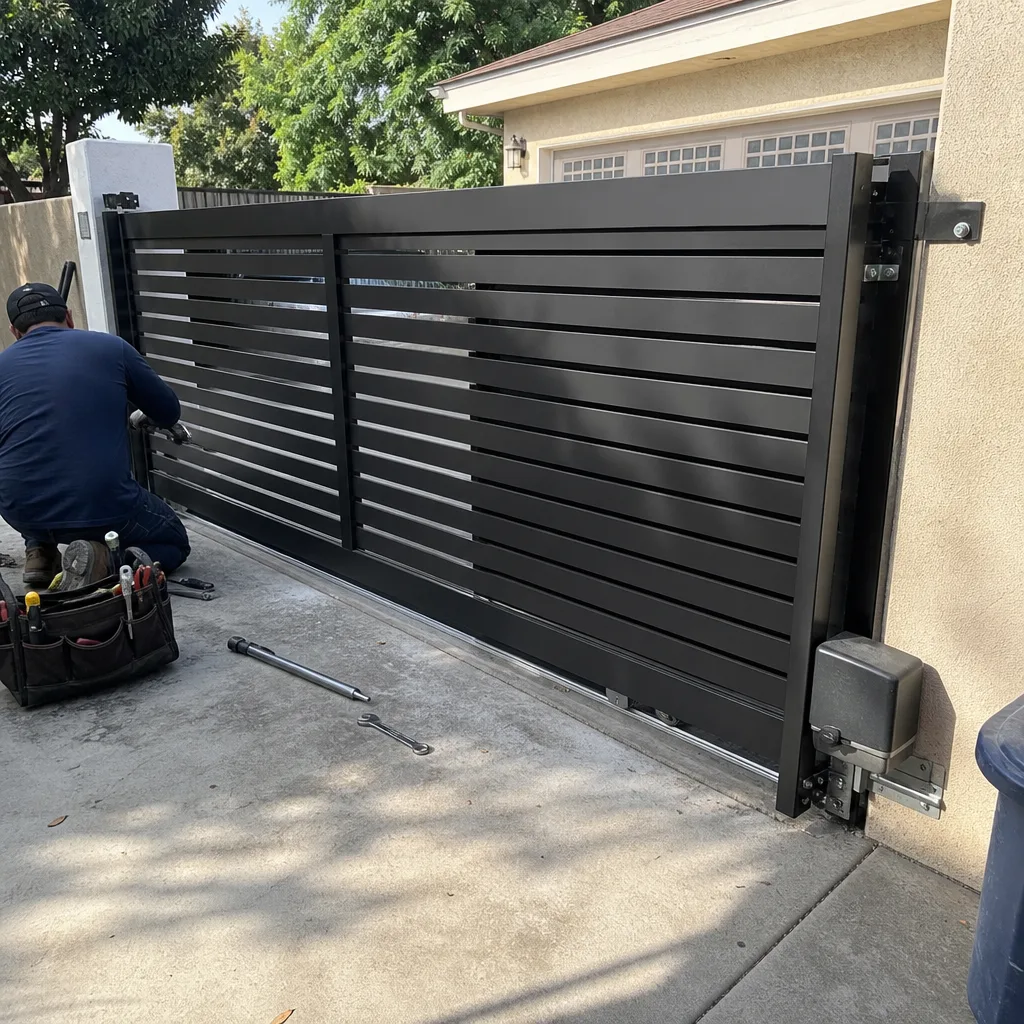 After
After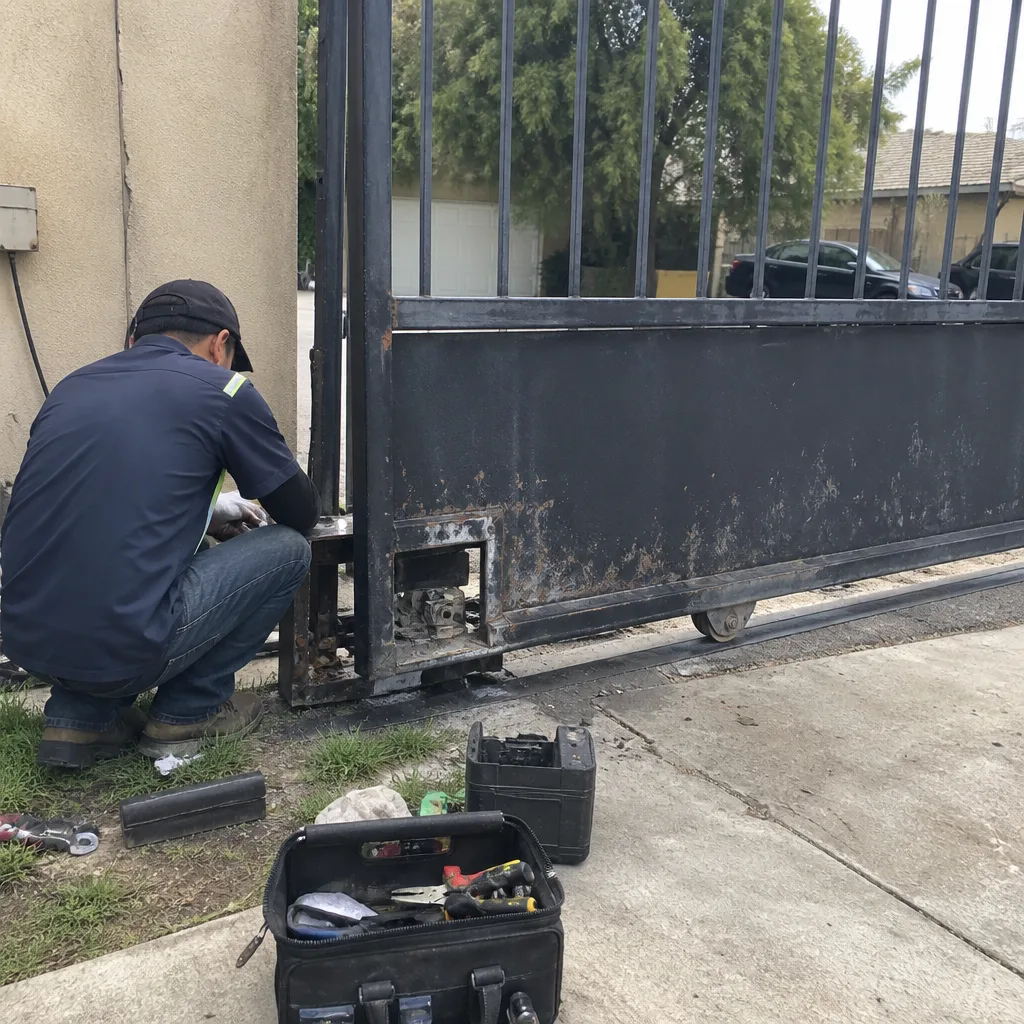 Before
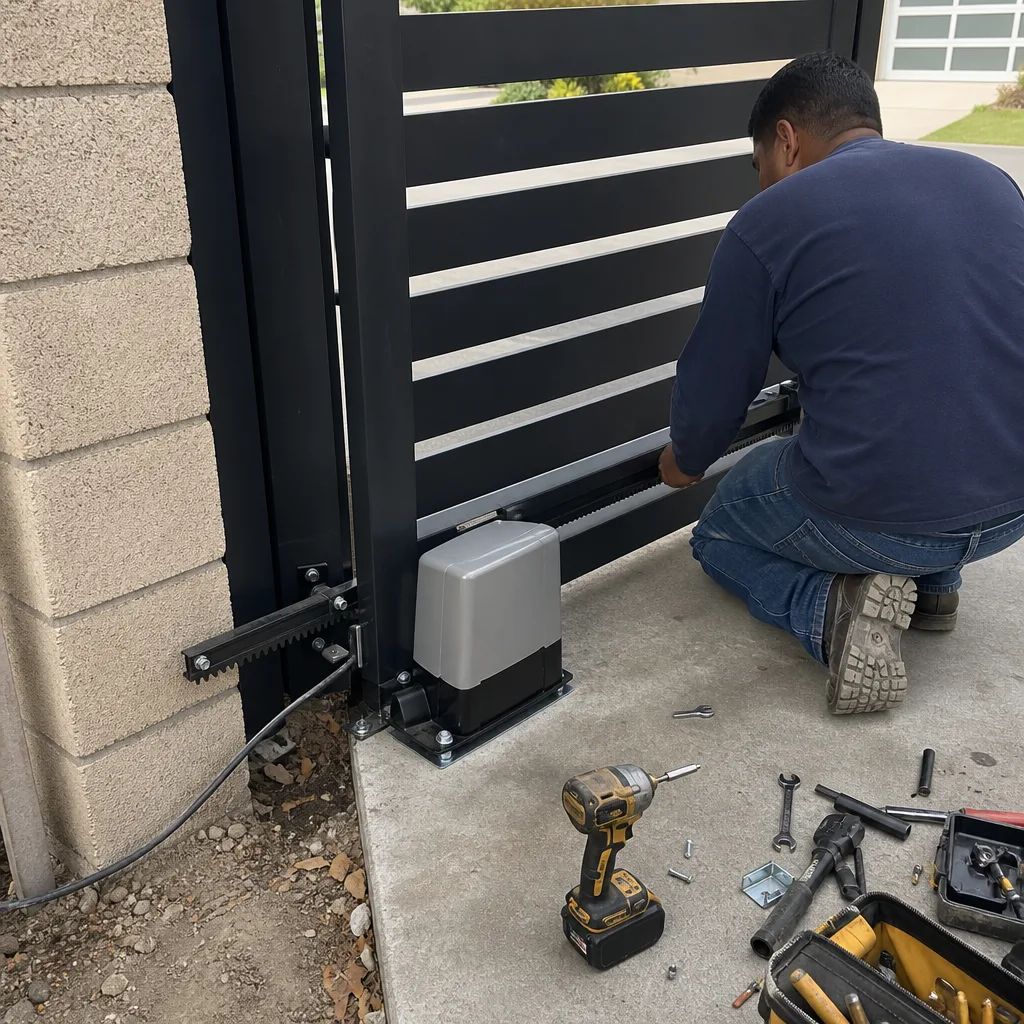 After
AfterGate Repair Maintenance Checklist for Cerritos Homeowners
Most driveway gates in Cerritos don’t fail because they’re old. They fail because nobody looked at them for nine months. The coastal-influenced air that keeps Cerritos mild also carries moisture and fine dust that works its way into hinges, tracks, and motor housings. A gate that gets ten minutes of attention four times a year will routinely outlast one that gets ignored until it groans. This guide walks you through exactly what to check, when to check it, what you can handle yourself, and when the smart move is to pick up the phone. And we’ll be straight with you about the things that genuinely need a trained hand, because some of this equipment can hurt you.
Quick Answer
A Cerritos homeowner should inspect their gate once per quarter, focusing on hinge lubrication, track alignment, opener force settings, and safety sensor function. The most neglected item is almost always the hinge bearing, and the most common season for failures in Cerritos is late summer, when the marine layer finally burns off and the metal expands in sustained heat after months of damp mornings.
Table of Contents
- Why Gates Fail in Cerritos
- What You’ll Need to Inspect Your Gate
- The Monthly Walk-Around (5 Minutes)
- The Quarterly Deep Check (30 Minutes)
- Seasonal Patterns: What Breaks and When
- Opener and Automation Maintenance
- Hinges, Wheels, and Welds: The Structural Check
- Safety Sensors: The Part That Protects Your Family
- Common Mistakes to Avoid
- When to Call a Professional
- Frequently Asked Questions
- The Bottom Line
Why Gates Fail in Cerritos
Before you touch a wrench, it helps to understand what you’re up against. Cerritos sits about ten miles inland from the Pacific, which means the air here is a specific kind of environment for metal and electronics. Morning marine layer deposits moisture on exposed steel and aluminum surfaces. By early afternoon, the sun has burned through and temperatures climb. That daily cycle, damp to dry, cool to hot, happens roughly 300 days a year.
What does that do to a gate? Three things we see constantly in the neighborhoods north of Artesia Boulevard and south of the 91.
First, surface rust at the base of the gate frame. Sprinkler overspray is the usual culprit. Cerritos homeowners famously keep green lawns, and those irrigation systems frequently spray sideways. A gate post sitting in perpetually damp soil with lime and mineral deposits from hard water will rust from the bottom up, often while the top of the gate still looks fine.
Second, opener force settings drift. Temperature swings cause metal to expand and contract. Over months, a gate that once opened smoothly binds slightly against its track or post. The opener compensates by pushing harder. That extra force wears the motor, stresses the chain or belt, and eventually triggers the safety reverse at random intervals. Homeowners then assume the opener is broken, when the real issue is the gate itself moving out of alignment.
Third, hinge bearings seize. Most residential swing gates in Cerritos use either ball-bearing hinges or simple greasable barrel hinges. The ball-bearing type is sealed, which is good, but the seals dry out and crack over five to seven years. Once moisture gets in, the bearing rusts internally and locks. The gate still moves, but it grinds, and the opener is now fighting a seized joint on every cycle. That’s how motors die young.
None of this is catastrophic if caught early. All of it is expensive if ignored. The checklist below is built around catching these specific failure patterns before they take out your opener, your hinges, or your gate frame.
What You’ll Need to Inspect Your Gate
You don’t need a mechanic’s tool chest. A few basic items cover 90 percent of what a homeowner should be doing. None of this involves opening the motor housing or touching electrical components, which we’ll address separately.
- A lithium-based spray grease for hinges and pivot points. White lithium in an aerosol can works well. Avoid WD-40 as a lubricant. It displaces moisture but doesn’t leave a lasting film, and it can actually wash out existing grease over time.
- A clean rag to wipe down tracks and rails before lubricating.
- A level, ideally a 2-foot version, to check gate post plumb.
- A spray bottle with mild soapy water for cleaning photo eye lenses.
- A notepad or your phone’s notes app to record what you see. Half the value of a maintenance routine is having a baseline, so you notice when something changes.
One more thing: if your gate is a sliding gate on a steel track, you’ll want a stiff brush. Cerritos dust, especially in neighborhoods near the San Gabriel River channel where the wind picks up, settles into track grooves and mixes with lubricant to form a paste that binds rollers. A stiff brush clears it in seconds.
The Monthly Walk-Around (5 Minutes)
This is the routine that catches 80 percent of problems before they become repair calls. Set a recurring reminder on your phone for the first Saturday of the month. Five minutes, no tools required except maybe the rag.
Here’s the walk-around, in order:
- Open and close the gate fully one time. Stand where you can see the entire travel path. Watch the gate, don’t just listen. Does it hesitate at any point? Does it speed up or slow down unexpectedly? Does it wobble side to side? A smooth gate moves like a pendulum; anything less is the gate telling you something.
- Listen while it moves. A healthy gate is quiet enough that you hear the opener motor humming, not the gate itself. Grinding, squealing, clicking, or a rhythmic thump all have specific meanings. Grinding is usually a bearing. Squealing is a dry hinge. Clicking is often a chain or belt tension issue. A rhythmic thump usually means a wheel or roller is flat-spotted or something is caught in the track.
- Check the safety reverse. This is the single most important safety test you can do, and it takes twenty seconds. With the gate opening or closing, place your hand or a small object in the gate’s path. The gate should stop and reverse immediately. Do this once for the open direction and once for the close direction. If the gate doesn’t reverse, stop using the opener immediately and call a professional. A gate that doesn’t reverse is a serious safety hazard, especially in a city like Cerritos where many homes have young children and grandchildren visiting regularly.
- Look at the track or hinge area for debris. Leaves, mulch, tennis balls, kids’ toys, garden hoses. Anything sitting in or near the gate’s path. Sliding gates in particular will collect material against the track end. Clear it out.
- Check the photo sensors. Most modern gate openers have a pair of small lenses mounted low on either side of the gate opening. Wipe them with a dry or slightly damp cloth. Cerritos sprinkler overspray tends to leave mineral spots on these lenses, and a dirty photo eye will cause the gate to beep and refuse to close.
That’s it. Five minutes. If everything passes, you’re done for the month. If anything fails, that’s your signal to schedule a closer look. Victor Salinas, the owner at Ironworks Gate Co., has told every customer for over forty years: the gate will tell you what’s wrong if you pay attention before it seizes up completely.
The Quarterly Deep Check (30 Minutes)
Four times a year, give the gate a more thorough examination. This is where you’ll use the lubricant, the level, and the notepad. Do this at the start of each season: early January, early April, early July, early October. The seasonal timing matters because each season stresses different components in Cerritos.
Step 1: Lubricate Every Moving Joint
With the gate in the open position, find every hinge, pivot, roller, and bearing. Spray lithium grease directly onto each joint. Work the gate back and forth once or twice to distribute the grease. Wipe away excess so it doesn’t collect dust. On a swing gate, the hinge points are at the top and bottom of the gate where it attaches to the post. On a sliding gate, pay attention to the rollers and the guide tracks.
A note on Cerritos dust: neighborhoods in the northern part of the city, near the LA County line, tend to collect more airborne dust from the 605 and 91 corridors. In those areas, use grease sparingly. A light film lubes fine; a heavy buildup becomes a dirt magnet.
Step 2: Check Gate Post Plumb
Place your level vertically against both gate posts. The posts should read plumb, or within a hair. If a post is leaning, even slightly, that’s a structural issue, not a cosmetic one. A leaning post transfers uneven weight to the hinges, causing accelerated wear and eventually gate sag. In Cerritos, where most residential lots are relatively flat and soil is stable, post lean is almost always caused by either a vehicle impact, tree root pressure, or original installation with an undersized post footing. If you see lean, note it and call for an evaluation. Post issues left unaddressed turn a $200 hinge job into a $2,000 re-setting job.
Step 3: Inspect the Gate Frame
Run your hand along the bottom rail of the gate frame, especially at the corners. Look for bubbling paint, rust blooms, or cracked welds. On steel gates, the first sign of trouble is almost always a rust bubble at a weld joint. On aluminum gates, look for white powdery oxidation at joints, which indicates galvanic corrosion where steel hardware meets aluminum frame.
If you find a cracked weld, do not try to ignore it. Cracks propagate. What starts as a hairline split across a bottom corner weld becomes a full structural failure within months, and a gate that comes off its hinge is a serious hazard. This is the kind of thing a Ironworks Gate Co. home visit is designed for, and we’ll say it plainly later in this guide.
Step 4: Test the Manual Release
Every automatic gate opener has a manual release mechanism. On most brands, including FAAC and BFT models common in Cerritos, it’s a pull handle or keyed release on the operator arm. The manual release lets you open and close the gate by hand when the power goes out or the opener fails. Test it quarterly. Pull the release, move the gate manually through its full travel, and reconnect. The gate should move freely by hand with reasonable effort. If a swing gate feels heavy or a sliding gate feels rough, that’s a sign the opener has been working harder than it should, which shortens its life.
Step 5: Record What You See
Write down anything you noticed, even if it seemed minor. “Hinge on lower right sounds dry.” “Gate hesitates for a second at midpoint.” “Slight rust bubble at bottom left corner.” These notes become invaluable when you’re trying to figure out whether a problem is new or has been developing for six months. They’re also helpful if you ever call us for service, because the more precisely you can describe the symptom, the better prepared the technician is on the first visit.
Seasonal Patterns: What Breaks and When
We’ve been working on gates in Cerritos since long before some of the city’s current residents bought their homes, and the seasonal rhythm of failures is remarkably consistent. Here’s what we see, season by season.
January through March: The Rainy Season Check
When the rains come, usually lightly but persistently, moisture gets into everything. This is the season for electrical gremlins. Water intrusion into the opener housing, corroded wire splices, and photo eyes shorting out. It’s also the season when gate hardware rusts fastest, because the metal stays damp for days at a time.
Your job this season: after any sustained rain, check that the opener housing is dry. Look for water beading on the inside of the housing cover. Check wire connections at the opener for white or green corrosion. If you see any, that’s a service call. Do not try to clean electrical corrosion yourself.
April through June: The Adjustment Season
Spring in Cerritos is usually mild and dry. This is the ideal season for annual tune-ups, adjustments, and any deferred maintenance. The metal isn’t under thermal stress, and the ground has settled from winter moisture. If your gate has been sagging or binding, this is the window to fix it before summer heat makes everything tighter.
July through September: The Expansion Season
This is when we get the most emergency calls in Cerritos. Sustained heat expands the gate metal. A gate that was binding slightly in spring will bind noticeably in August. Motors overheat and trip their thermal protection. Welds that were under stress all year crack under the additional thermal expansion. And the marine layer that kept the metal wet through June now leaves a baked-on mineral film that accelerates corrosion in any micro-scratch in the paint.
Your job this season: if the gate starts behaving differently in July or August, don’t wait for October to address it. Heat-related binding only gets worse. A gate that trips the opener’s thermal protection once will trip it again, and each thermal trip puts additional stress on the motor windings.
October through December: The Recovery Season
The air cools, the gate contracts, and for a few weeks everything quiets down. This is the season when homeowners forget about the gate entirely, which is exactly what we recommend against. Use October and November to address wear accumulated over the summer. Replace worn hinge bearings before the winter rain arrives. Touch up paint chips. Check the photo eyes and safety sensors one more time before the holidays, when gates see their heaviest traffic of the year.
Opener and Automation Maintenance
The opener is the part that does the work, and it’s the part most people never think about until it fails. We service nine major automation brands, including FAAC, BFT, Linear, and Viking, and the maintenance principles are similar across all of them.
What You Can Check Yourself
- Force settings. Most modern openers have adjustable force limits. After months of normal wear, a gate that once opened easily may require slightly more force. If you find yourself needing to increase force more than a small amount, the problem isn’t the opener. It’s the gate. Increasing force settings to compensate for a binding gate only transfers the stress to the motor and the gate frame. A properly maintained gate should open reliably on its original force settings.
- Limit switches. The limit switches tell the opener where to stop. If your gate slams against the stop or stops short and then reverses, the limits may have drifted. Many openers allow homeowner adjustment, but check your manual first. Improper limit adjustment causes unnecessary impact forces that eventually crack welds.
- Battery backup. If your opener has a battery backup, test it quarterly by cutting power to the opener and running the gate. Batteries have a lifespan of three to five years. A dead battery backup means your gate is locked in position during a power outage, which becomes a real problem if a family member needs to get a car out during an emergency and can’t reach the manual release.
What Belongs to a Technician
Any electrical work inside the motor housing, any control board diagnostics, any wiring repair, and any adjustment that requires opening the sealed sections of the operator, belongs to a trained person. Gate openers run on 110-volt or 220-volt current. A wrong move inside that housing can cause serious injury or death. This isn’t a warning about the gate being annoying. It’s a warning about the gate being dangerous.
We’ve seen homeowners try to save a service call by opening the motor housing and end up with a shorted control board, a voided warranty, or worse. The control boards in modern openers from brands like Viking and BFT are sensitive electronics. Static discharge from a finger can damage a board. If you wouldn’t open your electrical panel, don’t open your gate operator.
Hinges, Wheels, and Welds: The Structural Check
This is the section that separates a long gate life from a short one. The opener does the work, but the framework carries the load. And in Cerritos, where many homes have ornate steel or aluminum gates that were custom-fabricated, the framework is doing a lot of work every day.
Hinges: The Most Neglected Component
A swing gate hangs on two or three hinges. Each hinge takes the full weight of the gate every time it opens and closes, which for most Cerritos households is four to eight times per day. Over a year, that’s roughly 1,500 to 3,000 cycles. Over ten years, 15,000 to 30,000 cycles. A hinge bearing that seizes puts the entire load on the remaining hinges, accelerating their wear and stressing the gate frame at the hinge attachment points.
Signs of hinge trouble: the gate sags toward the latch end, the gap between the gate and the post is uneven top to bottom, the gate rubs against the ground or the post, or there’s a grinding feel when you move the gate manually. Any of these is a service call. A seized hinge rarely frees up with lubricant alone, and running the opener on a seized hinge is the fastest way to burn out a motor.
Wheels and Rollers: The Sliding Gate’s Workhorses
Sliding gates ride on a set of steel or nylon wheels that sit in a track or on a rail. These wheels carry the gate’s full weight and are constantly exposed to dust, moisture, and whatever else the wind blows into the track. Cerritos neighborhoods near the 605, where wind and dust are more prevalent, see faster wheel wear than sheltered interior streets.
Signs of wheel trouble: the gate wobbles as it slides, the gate makes a rumbling sound, the gate is harder to push manually than it used to be, or you see flat spots on the wheels when you inspect them. Flat-spotted wheels create a thump that you’ll hear on every cycle and that transfers impact forces directly into the gate frame.
Welds: The Silent Failure Point
Weld failure doesn’t announce itself. It starts as a hairline crack, invisible unless you’re looking for it, usually at a corner joint or where a decorative element attaches to the main frame. Over months of thermal cycling and operational stress, that crack grows. Some welds fail in compression (the gate pushes against them) and some fail in tension (the gate pulls on them). Tension failures are more dangerous because they can release suddenly.
When to look: during your quarterly deep check, run a flashlight along every weld joint. Look for dark lines, rust stains, or paint that’s slightly raised or flaking at the joint. On painted gates, a crack often shows as a thin rust line bleeding through the paint. If you find one, schedule a repair. Our welding service at Ironworks Gate Co. handles cracked pickets, broken hinges, and full frame repairs, and every job is covered by the 90-Day Done Right Promise in writing.
Safety Sensors: The Part That Protects Your Family
This section is important enough to stand alone. Safety sensors are not optional equipment. They’re the difference between a gate that stops when a child steps into its path and a gate that doesn’t. Modern gate openers in the United States are required to have either photo eyes, contact edges, or both. Photo eyes project an invisible beam across the gate opening; contact edges are pressure-sensitive strips mounted on the gate’s leading edge.
Photo eyes need clean lenses and proper alignment. A direct hit from a sprinkler or a bump from a passing bicycle can knock a photo eye out of alignment. When a photo eye is misaligned, most openers default to fail-safe mode, meaning they beep and refuse to close. That’s annoying, but it’s the correct behavior. If your photo eyes are misaligned and the opener still closes, that’s a serious problem that needs immediate professional attention.
Contact edges are physical safety sensors. They should be tested every month as part of your walk-around. Activate the gate and press firmly on the contact edge. The gate should reverse immediately. If the contact edge is hard, cracked, or unresponsive, stop using the automatic function and call for service. A contact edge that fails means the gate will not stop if it encounters an obstacle, and the consequences of that failure can be tragic.
We’ll be direct because this matters: if your gate’s safety sensors are not functioning, disable the automatic opener and operate the gate manually until it’s repaired. The inconvenience is temporary. The alternative is not something any of us want to think about. If you’re in Cerritos and your sensors need attention, call us. We’ll be there when we say, with the parts on the truck to make it right on the first visit in most cases.
Common Mistakes to Avoid
After over four decades of repairing gates in Cerritos and the surrounding communities, here are the mistakes we see over and over, from homeowners who meant well.
- Using WD-40 as a lubricant. It’s a moisture displacer and a solvent, not a lubricant. It strips grease out of moving joints and leaves them drier than before. Use a lithium-based grease on hinges and pivot points. It stays in place and handles the load.
- Ignoring a squeak because “it still works.” The squeak is the gate telling you a joint is dry and wearing. Grit is grinding into the bearing surface. A few dollars of grease at the right time prevents a few hundred dollars of hinge replacement later.
- Forcing the gate past a bind. If the gate sticks and you push it past the sticking point, you’re bending something. It might be the track, the hinge, or the gate itself. Find the cause of the bind before you apply more force.
- Disabling safety sensors because they’re “annoying.” When photo eyes get knocked out of alignment, the gate beeps and refuses to close. We understand the frustration, especially when it happens at night or before work. But disconnecting the sensors because they’re inconvenient turns a nuisance into a dangerous piece of machinery. Fix the alignment, don’t disable the safety.
- Waiting for “the next big storm” to call about post lean. A leaning post doesn’t get better on its own. Every cycle of the gate puts additional strain on the hinge, the frame, and the post footing. In Cerritos, where the soil is relatively stable, a leaning post is a symptom of something specific, and that something usually gets worse with time.
- Oil-based paint touch-ups on powder-coated gates. Powder coating is a baked-on finish that oil-based paint doesn’t adhere to well. If you touch up chips with the wrong product, you may accelerate corrosion by trapping moisture under a poorly bonded patch. Match the coating type or have the gate professionally refinished.
- Adjusting springs and tensioners without training. Some gates, especially heavier custom steel gates, have counterbalance springs. These springs are under tremendous tension and can cause severe injury if they release while you’re working with them. This isn’t a job for a weekend project. Call someone who knows what they’re doing.
When to Call a Professional
Here’s the line we draw, clearly. Call a professional when the gate has a structural problem (leaning post, cracked weld, broken hinge), when the opener is malfunctioning (won’t respond, trips repeatedly, makes burning smells, won’t reverse), when safety sensors aren’t working properly, or when electrical work is needed inside the operator housing. Also call if you hear grinding that doesn’t resolve with lubrication, or if the gate has come partially off its track or hinges.
We’ve said it a few times in this guide, and we’ll say it once more: gate hardware can be genuinely dangerous. High-tension springs, heavy moving metal, 110-volt electrical current. If any of those are involved, the smart move is a trained, insured technician. Ironworks Gate Co. offers free estimates in Cerritos. Call (747) 298-3226, speak to a live person, and get an honest assessment. If it’s something you can fix yourself with ten dollars of grease, we’ll tell you that too.
Frequently Asked Questions
A five-minute visual and functional check every month, and a 30-minute deep check every quarter is the right cadence for most Cerritos homes. The monthly check catches safety issues and obvious problems; the quarterly check addresses lubrication, alignment, and structural wear before they become failures. Gates that see more than ten cycles a day, or gates on busy streets like South Street or Pioneer Boulevard, may need attention more frequently.
Seized hinge bearings and burnt-out opener motors are the two most common repairs we see in Cerritos, and they’re usually related. A hinge seizes, the opener works harder to overcome the resistance, and the motor burns out trying. The fix for the hinge is straightforward; the fix for the motor is more involved. This is why checking hinges regularly saves money: the ten-dollar grease job prevents the $400 motor replacement.
Yes, and you should. Use a lithium-based spray grease, apply it to every hinge and pivot point quarterly, and wipe away excess. What you should not attempt is hinge replacement or disassembly. A gate hanging on its hinges carries hundreds of pounds, and if the gate comes off during disassembly, it can cause serious injury.
It helps to work with someone who knows the brand. FAAC openers have specific adjustment procedures and common failure points that differ from other manufacturers. At Ironworks Gate Co., we carry training and parts for FAAC as well as BFT, Linear, Viking, and five other major brands, so the right fix happens on the first visit regardless of what’s on your driveway.
Most residential gate repairs in Cerritos fall between $180 and $600, depending on the component and the extent of the damage. Hinge lubrication and adjustment is on the low end. Opener control board replacement is on the high end. Full gate frame welding repair typically runs higher. The exact number depends on your gate, your opener, and what’s actually wrong, which is why we quote every job before work begins. Call (747) 298-3226 for a free estimate, and the price you’re quoted is the price you’ll see on the invoice. No surprises.
We do. Our $89 Seasonal Tune-Up covers the full quarterly checklist: lubrication, opener adjustment, safety sensor testing, limit switch calibration, and a written report on anything we find. It’s designed to catch the small problems before they become repair calls, and it’s priced so that regular maintenance is cheaper than the alternative. Senior and veteran homeowners receive a 5 percent discount on all services, always.
The Bottom Line
A well-maintained gate in Cerritos is not an accident. It’s a habit. Five minutes a month, thirty minutes a quarter, and the discipline to call a professional when the problem is beyond a homeowner’s tools and training. Hinges want grease, sensors want clean lenses, welds want inspection, and openers want a gate that moves freely. Give the gate those things and it will outlast most cars in the driveway. Ignore it, and the bill will find you eventually. For those who’d rather hand the whole task to someone who’s done it a few thousand times, we’re here. Call (747) 298-3226 and a live person will answer. That’s been true for over 42 years, and it’ll be true tomorrow.
Written by Victor Salinas, Owner at Ironworks Gate Co., serving Cerritos since 2013.